Category Archives: Uncategorized

Strategic Leadership and the Mind of God

Strategic leadership begins with the mind of God revealing His plan.

Now the Lord said to Joshua: “Do not be afraid, nor be dismayed; take all the people of war with you, and arise, go up to Ai. See, I have given into your hand the king of Ai, his people, his city, and his land. And you shall do to Ai and its king as you did to Jericho and its king. Only its spoil and its cattle you shall take as booty for yourselves. Lay an ambush for the city behind it. – Joshua 8:1-2

A little context is necessary here. A few chapters earlier in Joshua, the people had obeyed exact instructions from the Lord, attacked Jericho with some very unconventional tactics and had seen God do a miracle in defeating that great city. Then they went to attack the city of Ai which was a lesser city. The spies they sent said the city didn’t need a full-scale attack so they sent a small group to take it. They got beaten badly and chased by the enemy. They were pretty discouraged and ready to return to cross back over the river. To be sure, the main reason for the defeat was sin in the camp of Israel but it should be noted they did not seek out God’s plan for this battle; they relied on previous experience. We often do the same.

As well as the sin in one person, there was a greater sin of relying on previous experience and their own abilities rather than seeking God’s wisdom and His plan. God’s initial response to them is to encourage them after their loss.

Confidence in man leads to failure before God but man can learn from his failures if he has a humble heart. Failure helps us to distrust ourselves, to know God better and to rely on him.

For those who walk intimately with God, great success leads to even greater humility. For those who do not know God well, success can lead to a prideful stance.

Joshua’s strategic plan:

  • He receives the target and plan from God.
  • He plans the details relying on God’s direction.
  • He employs the whole army.
  • He implements the plan relying on God to work.
  • God gives victory.

Some lessons from this story

  • Strategic leadership begins and ends with God in all its phases of thinking, planning and execution.
  • The purpose of strategic leadership is to establish God’s reign in this world by overthrowing what is man-made and replacing with God’s desires.
  • The secret of victory with God is to obey.
  • Human tendency is to stop short and put aside what God said and do what man thinks is right.
  • If leaders don’t seek God’s mind, failure will follow.
  • God’s guidance is dynamic. We must not rely on what we knew yesterday to act today. We must know His mind.

Note: this blog is a summary of a devotion given by Djasrabe Siangar at the African Round Table in Nairobi, Kenya October 22, 2023
Thinking Strategically

As mentioned in the post “Strategic Leadership and the Mind of God”, all effective godly strategic leadership begins with seeking the mind of God. Once we have committed our way to Him and are seeking to fulfill His desires, we can begin the work of planning our actions. Before we jump into that process, we must be assured we are thinking strategically.

Proactive versus reactive

Due to the enormous needs and challenges we face as leaders, it is often hard not to get caught up in what some have referred to as “the tyranny of the urgent“. (for an entertaining clip that shows a man playing “Whack-a-mole” see this presentation by Dr. Lori Behar)

Sometimes crisis comes along when we have no choice but to react with little time to really think through the process but for many leaders, this is a way of life that is often justified by us saying “God is in control”. While of course He is in control, reactive is not a lifestyle He desires for us.

Proactive VS REACTIVEwHAT’S THE DIFFERENCE?
Proactive Reactive
Before it happens After it happens
Intentional Driven Urgency driven
Easy to ignore Impossible to ignore
Anticipating needs and challenges Disconnected Responses

Some questions for thought:

    • How does reactive thinking affect the mission?
    • How do we need to increase proactive thinking?
    • Where am I at in the amount of proactive or reactive thinking?
    • Do I take the time needed to think proactively?
    • Where do I need to grow?
    • What are the consequences if I don’t?

Nehemiah’s Strategic Example

Nehemiah 6:3 – Can we learn something from Nehemiah in the building of the wall?  In this verse he says “I am carrying on a great project and cannot come down, I am doing a great work.”  His enemies were trying to distract him from the work but he would not drop what he was doing to engage them.  What do we know about him and how could he make this statement?  How does his response show his leadership and in particular, his strategic thinking?

Proactive Thinking

  1. Get to the Balcony – Look from above – where are you going? What are the trends? Where are the open doors to build movements?  What are the issues that need to be addressed?
  2. Connected to the reality – What is the reality on the ground? Morale? Volunteers? Trust? Fruitfulness? What is essential that is working? What is not? What is weighing us down?  What things do we need to try?

Categories of engagement

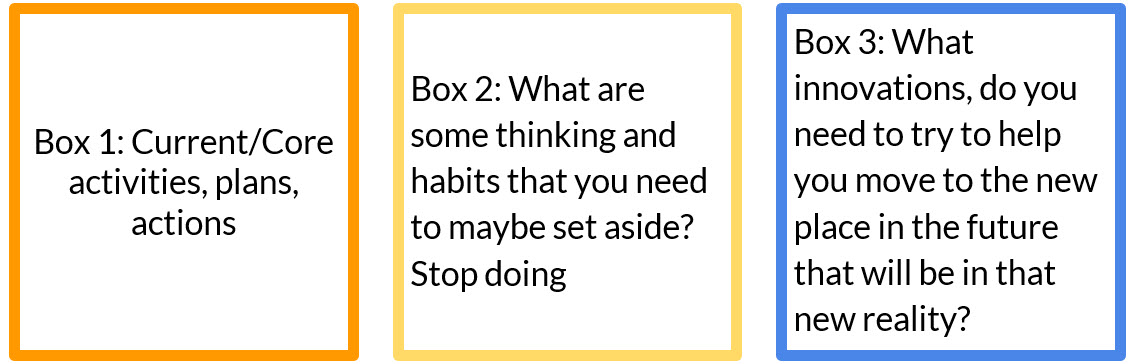
Where do you think we spend most of our time?

boxes we spend most time in

The goal is to build sustainable movements for fulfilling the Great Commission. As you think about the above boxes, what do you think should go in each one? (starting in the second and then thinking about box 3). Box 1 contains things we need to keep doing while we think about the future.

Reflection

  • Take some time alone to think about how much time you spend thinking about box 2 and box 3?
  • How will you incorporate the proactive thinking of box 2 and 3 into your leadership?

Note: this blog is excerpted from a talk given by Dr. Lori Beyar on October 22, 2023 at the African Round Table gathering in Nairobi, Kenya

Biblical Strategic Planning

  • A vision without a strategy remains an illusion. (Lee Bolman)
  • Without strategy, execution is aimless. Without execution, strategy is useless. (Morris Chang)
  • When a plan or strategy fails, people are tempted to assume it was the wrong vision.  Plans and strategies can always be changed and improved. But vision doesn’t change.  Visions are simply refined with time. (Andy Stanley)

The concept of Strategic Planning has been around for a long time.  This is not something new.

    • Noah used it in the project of building the ark.
    • Moses demonstrated strategic planning and leadership in guiding the Israelites out of Egypt and through the wilderness to the Promised Land. He developed a clear mission and strategy, organized the people into tribes, and delegated responsibilities to leaders within each tribe. 
    • Nehemiah used it in rebuilding the walls of Jerusalem.
    • Solomon’s construction of the Temple in Jerusalem involved strategic planning and execution. He developed a detailed plan, organized the workers and resources, and managed the project to completion. 

What is Strategic thinking?

    • Strategic thinking is simply an intentional and rational thought process that focuses on the analysis of critical factors and variables that will influence the long-term success of an organization, a team, or an individual. 
    • Strategic thinking includes careful and deliberate anticipation of threats and vulnerabilities to guard against and opportunities to pursue. 
    • Ultimately, strategic thinking and analysis lead to a clear set of goals, plans, and new ideas required to survive and thrive in a VUCA (volatility, uncertainty, complexity, and ambiguity) environment. 
    • This sort of thinking must account for economic realities, market forces, and available resources.

Strategic thinking in strategic planning

    1. Identifying opportunities and challenges
    2. Setting a clear direction 
    3. Analyzing and prioritizing options
    4. Developing innovative and creative solutions 
    5. Considering multiple perspectives 
    6. Anticipating future scenarios 
    7. Integrating short-term and long-term perspectives
    8. Learning and continuous improvement

Strategic Planning Tips

    1. Clearly define your mission, vision, and values to correct lack of alignment
    2. Conduct a comprehensive situational analysis (SWOT/ PESTEL) (Strengths, Weaknesses, Opportunities, and Threats/Political, Economic, Social, Technological, Environment, and Legal)
    3. Set SMART goals (Specific, Measurable, Achievable, Relevant, and Time-bound)
    4. Involve key stakeholders to correct poor communication and engagement
    5. Foster a culture of collaboration and innovation
    6. Prioritize and allocate resources effectively (Budgeting)
    7. Develop an actionable implementation plan (Organize)
    8. Communicate and cascade the plan to avoid siloed thinking
    9. Monitor progress and adapt as needed to accommodate external environmental changes – Macedonian call (refers to a God-given vision that directed the route Paul took on his second missionary journey)
    10. Foster a culture of continuous improvement

Note: for suggestions on planning tools and ideas, refer to other articles on this site as well as other external sources.  The principles given above, when followed will lead you to effective plans 

Some thought questions for you to ponder as you look at your current plans

    • What difficulties did you encounter in coming up with a credible plan?
    • As you think through building a plan to address your priorities, what challenges created the most difficulty?
    • How will you address those challenges?
    • Who could you ask for help? (most likely others have encountered similar issues and have found a way around them)

Note: This blog is an excerpt from a talk and discussion given by Dr. Moses Chungdu October 23, 2023 in Nairobi, Kenya at the African Round Table.

Strategic Implemetation

STRATEGIC EXECUTION IN THE BIBLE

    • Joseph demonstrated the power of strategic planning and execution when he handled the famine in Egypt rightly from the interpretation of the dream to the mitigation of the famine.
    • Joseph did not end with interpreting the dream but went on to plan and Pharoah felt Joseph was best placed to implement it.
    • He had an elaborate plan which he executed to the end.
    • He could have left it to the God who had interpreted the dream to bring it to pass but he trusted Him enough to plan for it and followed the plan.
    • Faith does not go against reason it goes beyond it.

STRATEGIC PLANNING EXECUTION PITFALLS

    • Lack of leadership commitment 
    • Poorly defined goals and objectives
    • Inadequate resource allocation 
    • Insufficient communication and engagement
    • Lack of accountability and ownership
    • Siloed organizational culture and coordination challenges
    • Inadequate monitoring and evaluation (KPIs)
    • Inflexibility and resistance to change
    • Lack of adaptability and learning
    • External environmental factors 

MEASUREMENT CHALLENGES IN STRATEGY EXECUTION 

We will not be able to determine if we have executed properly if we don’t measure our progress.  What are some of the challenges we can encounter?

    • Lack of clear and measurable objectives
    • Limited availability of quality data
    • Our metrics don’t align with our strategic goals
    • Complexities and interdependencies of our initiatives
    • Time lag between our actions and our outcomes (by the time we get the data, it’s too late to do anything about it)
    • Resistance to measurement and accountability
    • Cultural and/or organizational barriers

Example of success from one of our national team leaders

One country went from not being very successful to enjoying the benefits of their planning.  Here is what they did differently to change the outcome.

  • The leaders made a decision that they needed a planning tool and to consistently use it.   It wasn’t the tool itself, it was the commitment to use it.
  • They looked at their national strategic plan once a month
  • They set weekly goals together as a team

Questions for thought

    • One of the impediments to effective strategy execution is poor organization. Reflect on your local ministry/strategy and discuss how best to organize yourselves for effective implementation (i.e. the right people in the right place doing the right assignment using the right tools/methods).
    • Based on your thoughts about the challenges of strategic planning and execution, are there people you could consult with who have been successful?

Note: this blog is an excerpt from a discussion let by Dr. Moses Chungu at the African Round Table on October 24, 2023 in Nairobi, Kenya.

Process to Develop “Strategic” Plans

A plan lists actions that can be taken. A “strategic” plan is one that identifies the actions that will lead to the most progress being made towards the vision.

Below is a simple process for prioritizing possible actions in a plan, so that the actions that are most likely to result in the most progress are given the highest priority.

  1. Agree what your key goal is for the organization from your strategic direction on the previous sheet. You will use this in Step 5 below.
  2. Identify your most limited resource. It is the thing that most constrains how much you can do. This is usually either money or availability of people or quantity of key materials available. You will use this in Step 4 below.
  3. List the possible actions that have been identified. These possible actions will have come from all constituents and staff.
  4. Estimate the amount of your most limited resource that each possible action would use. This might be, for example, the cost of the action, or the number of people that the action would occupy.
  5. For each possible action, estimate the size of the contribution made towards the key goal. This might be, for example, the expected number of multiplying disciples to result from the action, or the number of movements started, or the expected increase in staff support to be raised.
  6. For each possible action, calculate the contribution towards the goal per unit key resource used. This is calculated by dividing the result of Step 4 by the result of Step 5.
  7. Determine the priority (1, 2, 3, 4 etc.) for each possible action, with the highest priority actions being those actions with the lowest amount of key resources used per unit contribution towards the goal. In other words, the lower the number determined in Step 6 the higher the priority.
  8. Flesh out the details of the highest priority steps for action.

Are You Doing Planning or Strategic Planning?

Is your plan a strategic plan or just a plan?

Well, it depends upon your definition of “strategy”. This usually comes back to some sort of high level steps / plan / direction / actions. However, one person’s high level, is another person’s detail, depending upon where you sit in the hierarchy. So when you get rid of hierarchy, “strategy” comes sown to being the best things to do rather than just some good things to do.

Everyone can have a strategy – the route that they have determined is the best route to take to make the most progress towards a goal.

To determine the best thing to do you need to answer the hardest question, i.e. determine what steps you need to take to make the most progress towards your vision, given the resources available to you, not just some good progress towards your vision.

To determine the best things to do (i.e. determine what your strategy should be) you need to look at all of the alternatives and select the best. This boils down to some portfolio management, i.e. looking at all of the things (projects and ongoing work packages) that you are doing / can do, and focus on the ones that give the best results.

Here, here and here are some papers that describe Portfolio Management, and how to compare work packages to add the most value / make the most progress towards the vision.

You can find a short presentation that describes a process to select the optimum work to do to make the most progress towards your vision here.

So, does your team have plans, or does your team have a strategic plan?


Questions For Reviewing Plans

What should you look for when reviewing a plan for a national team in our organization? Here are the questions that I kept finding myself asking during reviews of our national plans recently. I hope that you find them useful. The questions should be asked pretty well in this order.

  • What are their objectives / desired outcomes?
  • Do the objectives line up with the Vision, Mission and / or strategic measurements of the global organization?
  • Are the objectives described as quantitative outcomes?
  • Does the SWOT analysis relate to the objectives?
  • Do the main steps / actions described in the plan relate to the objectives?
  • Do the main steps / actions described in the plan address the weaknesses / threats in the SWOT?
  • How many staff / employees are there in the country?
  • Are the objectives reasonable given the number of staff?
  • Are the actions reasonable given the number of staff?
  • Are there too few / too many different Mission Critical Components and or ministries for the number of staff in the country?
  • Are the main resources needed to implement the actions described in the plan?
  • Does it look practical to generate / obtain those resources given the history of the country?
  • Does the plan show the strategic steps that will make the most progress towards the vision?
  • What could go wrong to stop the desired actions from happening?
  • What might need to be done to mitigate these risks?
  • Is the national team on a clear path towards the Vision for their country in order to meet our Calling?

Fixing Teams That Don’t Work

Ever seen a plan that did not get executed because the team of implementors is dysfunctional? Well, it happens.

There are various tools that can be used to assess teams of people or individuals. These tools can help identify team dynamics that are holding back implementation of a strategy. Here is a summary of some tools that might help you. Credit for this should go to my expert colleagues, Greg and Anne.

Birkman

This assesses people’s areas of interest and their organizational focus. For each member of a team, it can identify what they like to contribute to the team’s work, and what they need from the rest of the team to work most effectively. Birkman can be used to identify imbalances in the makeup of a team, and to identify causes of possible breakdowns in team working. It looks at a person’s preferences in the subjects of esteem, acceptance, structure, authority, advantage, activity, challenge, empathy, change, freedom and thought.

BPMT (Building Powerful Ministry Teams)

This is a team assessment tool based upon “The Performance Factor: Unlocking the Secrets of Teamwork“. This tool helps a team self assess six different aspects of team working (common purpose, clear roles, accepted leadership, effective processes, solid relationships and excellent communication). Teams can then see which aspects of team working are failing, and take steps to address them.

Strengthsfinder

Stengthsfinder identifies the top 5 strengths that a person has out of a list of 34 possible strengths. This helps people determine what aspects of work they like the most. Teams can then use this information to help allocate tasks to play to the strengths and preferred working styles of their members. Hopefully this will save you allocating a detailed analysis task to someone who’s strength is blue sky thinking! One advantage of this tool is that it is positive – it focuses on strengths rather than weaknesses, so it create little negative conflict.

7Fs Personal Life Assessment

A simple self test that anyone can take to see if they have an appropriate life balance. This might help you identify people who are burned out because their overall life is out of whack. The assessee grades the strength of faith, fellowship, family, friendship, financial, fitness and fun in their life.

Job Description

Does everyone working on your project have a job description, and are they working according to it? This maybe a little obvious, but it maybe worth reviewing!! If there are no job descriptions, maybe that is a source of team conflict.

360 Review

This is a simple assessment that allows team members to see how they really perform in the eyes of their peers, supervisor and subordinates. This tests the team’s strengths and weaknesses in a more objective manner than self evaluation. Only use it with relatively self-confident people or people who really are not self-aware of major issues.

EQ-i

This is an assessment of the ability to succeed for individuals in a team. The complete explanation of the psychology behind the test is in the book The EQ Edge. EQ-i starts with creating self understanding, and then self regard, with the hope that it can help with other’s perceptions of team members. It grades self-perception, self-expression, interpersonal communication, decision making and stress management. This assessment tool can identify character and communication issues in team members that have been hindering a team’s ability to execute a strategy. If someone has some real issues, then assess them annually to cover those issues. If they do not have stand-out issues, then there is no need to assess them every year.

EQ-i 360

This is good for team members who have real blind spots that are bringing down a team’s ability to execute their plan. This uses the same assessment questions as EQ-i (above), but a person’s manager, peers, direct reports, family / friends and other people answer the questions as well as the person being assessed. You would certainly want to use it when you see EQ-i results that really don’t match up with your experience. When looking for work performance in a team, count the manager’s view with greater importance than the results of the other reviewers. When looking for character issues, count a team leader’s direct reports with greater importance than that of other reviewers. This tool could also be used with people who are doing well, but want to do better still.

Lean Management and Strategic Leadership

Lean management and strategic leadership are irrevocably interrelated.

McKinsey defines Lean Management as having four disciplines:

  • delivering value efficiently to the customer
  • enabling people to lead and contribute to their fullest potential
  • discovering better ways of working
  • connecting strategy, goals, and meaningful purpose

We define Strategic Leadership as:

  • Strategic leadership engages people in creative thinking, planning and execution to most effectively accomplish the vision.

In these two definitions

  • “delivering value efficiently” relates to “most effective accomplishment…”
  • “enabling people to lead and contribute” relates to “engaging people”
  • “discovering better ways” relates to “creative thinking, planning and execution”
  • “connecting strategy, goals and meaningful purpose” relates to “execution to … accomplish the vision”

I know that we did not have this correlation in mind when we defined strategic leadership, but the parallels impress me. This tells me that if we want strategic leadership, we can learn a lot from those who area teaching and leading lean management.

As we start our planning cycle for the year, a couple of things that really stand out to me from lean management are:

  • planning is devolved to the front line, not Area, National and Team leaders
  • better ways of doing things are discussed, rather than extending our work from last year’s practices

I recommend the following further reading on lean management:

McKinsey’s Insight introduction article to lean management

McKinsey’s detailed paper on lean management

The Logical Framework

Have you ever executed a plan, only to find that you did not accomplish your original goal?

The Logical Framework is a tool that will help ensure that the plan you execute causes you to deliver the outcomes needed to achieve the purpose you want that means you accomplish the goal you desire. The idea is that you link the things you do directly to the desired goal through a logical thought process.

In the Logical Framework you define success measures, verification method and assumptions behind each of the planned actions (the model calls these “Inputs“), “Outcomes” of executing the plan, the “Purpose” behind wanting those outcomes, and the end “Goal” you want to achieve.

The core of the Logical Framework is the “temporal logic model” that runs through the matrix. This takes the form of a series of connected propositions:

  • If these Inputs are implemented, and these Assumptions hold, then these Outcomes will be delivered.
  • If these Outcomes are delivered, and these Assumptions hold, then this Purpose will be achieved.
  • If this Purpose is achieved, and these Assumptions hold, then this Goal will be achieved.

This tool was developed by the US Aid government department to ensure that the ultimate outcomes of delivering humanitarian aid to a country were achieved as a result of the aid program. Basically, this is a reinforced outcome based approach to project planning.

For all of the detail, have a look at the following:

The Logical Framework, A Manager’s Guide

http://www.managementpro.com/articles-resources